Contrasting takes on religion and the young. There have been a number of stories like this Washington Post piece with vivid and interesting examples of 20-somethings embracing religion. (Link should allow door through the paywall.) https://wapo.st/3KltFEh
The newspaper stories aren’t misleading about specific cases. Obviously individual local churches may be growing and flourishing even as the national picture is one of stability or decline. But it is a reminder that there is pressure to generalize from specific instances to broad generalizations. Caution and perspective are helpful.
The president’s party almost always suffers in the House
Midterms are less than a year away so it’s time to look back at the record.
In the House, the president’s party has lost seats in all but four midterms since 1862, and one of those, 1902, was a year the House expanded so the Republican gains fell short of Democratic gains that year. After 1934 it wasn’t until 1998 that the president’s party gained seats, then the rare event repeated in 2002. Not since.
This regularity over 160 years is hard to attribute to the circumstances of the moment. Likewise the hope that “this year will be different” has been a forlorn one. The size of the seat loss, on the other hand, has varied considerably and is correlated with presidential approval (Clinton in 1998 and Bush in 2002 were unusually popular, as was Roosevelt in 1934) and the state of the economy. Popular presidents lose fewer seats, unpopular ones more. Good times go with smaller losses, bad times with greater losses.
In 2026 we will have the unprecedented circumstance of a large number of mid-decade redistricting decisions as the parties battle to see who can gerrymander the most seats to their advantage. That landscape is still being painted.
In the Senate the pattern of losses are much less dependable than in the House. The president’s party usually loses seats, and the gains have been small since the 1940s. The vagaries of which seats are up and how many for each party adds uncertainty to the Senate picture. And, of course, prior to 1913 the Senate was not elected by popular vote.
In the House, the second midterm for a president produces barely grater losses than the first midterm (an average of 28.9 in the second, versus 24.9 in the first.) There isn’t a “six-year itch” on the House side. The Senate has been a different matter, with second midterm losses averaging 6 seats rather than 2 in the first midterm (since 1946.) One plausible explanation for the Senate is that the 6th year is the reelection of a Senate class elected with the president for his first term. To the extent a winning first term president brings along some partisan companions, they run without his coattails 6 years later. The table shows the seat changes and the averages since 1946.
Next year there will be inevitable discussion of whether 2026 is Trump’s second midterm. Obviously it is in one sense. But for the Senate, this will be the class elected with Joe Biden in 2020, not the class elected with Trump in 2016. This group had mild pro-Democratic national forces either helping or hurting them in 2020. Given this difference in the election cycle, the average 6 seat loss may not be as good a representation of expectations for Senate seats in 2026.
They say there are no second acts in politics. In Wisconsin that has been the case for the last 27 years, at least when it comes to statewide contests for governor and U.S. Senate. Mandela Barnes’ entry in the 2026 governor’s race will attempt to break the dismal recent record.
Consider the examples of Tom Barrett (lost governor’s races in 2010 and 2012), Tim Michels (lost Senate race in 2004 and lost governor’s race in 2022), Russ Feingold (lost Senate races in 2010 and 2016), Eric Hovde (lost GOP primary for Senate in 2012, lost Senate race in 2024), and Mark Neumann (lost Senate race in 1998, lost GOP primary for governor in 2010 and lost GOP primary for Senate in 2012). Even Tommy Thompson, who won four races for governor, fell short 14 years later in his 2012 bid for the Senate. You have to go back to the 1970s to find a successful second act in Wisconsin statewide elections.
What does this record say about Barnes’ position in the 2026 race for governor? There are some advantages that are important. He will likely start out as the best known candidate in a field of some 7 or 8 candidates. In my Marquette Law School Poll of Wisconsin, Oct. 15-22, the three best known Democrats had name identification ranging from 22% (Hong) to 25% (Rodriguez) to 26% (Crowley), with the rest in the teens. Barnes was not included as he had not entered the race. At the end of his 2022 Senate race, Barnes had a name ID of 85%, though when he started that race as the sitting Lt. Governor his ID rate was 37% in Feb. 2022. There is falloff in ID between races. Barrett finished his 2010 governor’s race with 84% name recognition, which fell to 61% in Jan. 2012 at the start of the recall election. Feingold fell from 95% in 2010 to 75% in Jan. 2016.
In two recent polls that included his name (though unannounced at the time) Barnes was ahead in the Democratic primary field with 16% support in a Sept. 28-30 poll sponsored by Platform Communications and ahead with 21% in a TIPP poll conducted Nov. 17-21. In both polls all other candidates were below 10%, with a third to half of voters undecided. Those polls didn’t measure name recognition.
Barnes also has the advantage of having raised substantial money in his 2022 Senate bid, giving him a donor list to tap that none of the other candidates have.
Those are positive elements for Barnes and each gives him an initial advantage some eight months ahead of the primary.
The reason for doubt is the track record of candidates running statewide following a previous statewide loss. The second time around has not shown much improvement in general election vote percentage (though each won their second round primaries, except for Neumann).
Name ID
Repeat candidates begin their second races with lower name ID than when they finished their first race, with slippage of about 20 points for Barrett and Feingold. Hovde began both races with very low name ID. All ended their second races with high name ID, though Feingold didn’t quite reach the high levels he had in 2010.
Barnes began his 2022 Senate race with a name ID rate in the mid-30s, rising to the mid-80s. We don’t yet know how much that has declined since 2022.
The chart shows the changes in name ID across the year leading up to each election. There is need to rebuild name recognition in the second act, but candidates largely succeed in doing so, and start with a higher level than first time candidates.
Net favorable ratings
Each of these candidates has suffered declines in net favorability across their elections. Decline late in the campaign is apparent for each candidate. Feingold stands out for having net positive favorability in both races he lost. The others all ended in negative territory, with Barrett and Hovde more net negative in their second races than in their first. Feingold’s first and second are about equal.
Bottom line
We don’t know how the next eight months until the primary, and eleven months to the general election, will unfold. What these past second acts have shown in that initial advantages in name ID and campaign experience, including established donors, have not produced success in the second campaigns over the past quarter of a century. Barnes now has the chance to change that somewhat daunting record.
While it is natural to follow presidential approval using the single “overall” job approval measure, this misses the substantial variation in support for the president across various issues. Likewise overall approval ignores differences by party and how trends over time vary by party. Let’s take a look.
The data are from my Marquette Law School Poll (MULawPoll) national surveys conducted since President Trump returned to office. Polls are done about every two months. The national samples are of about 1,000 adults in all 50 states. (Full results, including toplines, cross tabs and methodology are found in reverse chronological order at https://law.marquette.edu/poll/category/results-and-data/ )
Over the year we’ve tracked a number of topics, starting in May for the individual issues, and in February with overall approval. Some topics have only been asked once or twice, as issues come and go.
The chart shows net approval (approve minus disapprove) for 11 topics, including overall approval, by party, over time. Let’s start with overall approval as a baseline. Republican net approval has remained high, starting at +78 in February and standing at +70 in mid-November. That is a modest 4 point decline in approval (89% to 85%) and similar rise in disapproval (11% to 15%). A large majority of the GOP is standing by Trump in overall approval.
Independents are a different matter. In February the net approval among independents was -26 which declined to -50 in November, almost doubling. Independent approval now sits at 25% with 75% disapproval. Independents make up about 16% of our national adult sample. Independents to lean to a party are classified as partisans here, so this is “pure” independents.
Not surprisingly Democrats are overwhelmingly disapproving of Trump, though even a bit more now than in February. Democrats started Trump’s second term at -82 net and are at -90 in November. Their approval declined from 9% to 5% over the year. In a nice symmetry, both Republicans and Democrats have moved a net 8 points more disapproving of Trump over the year, though from radically different starting points.
While interesting, the variation across issues is more revealing. Trump has maintained relatively strong support on border security, with partisan differences but only modest changes over time. This is also a topic for which he is less negative among Democrats and comes close to breaking even with independents (despite their -50 overall net approval.)
Tariffs is another issue where net approval has remained relatively stable over the year, though with lower net approval among each partisan group than for border security. Republican net approval was +42 in May and +48 in November, while independents moved from -48 to -56 and Democrats ended as they began at -90.
On immigration, there are been some decline among Republicans, while independents and Democrats have held fairly steady over the year. Compare the GOP line for immigration with that for border security.
On the economy and inflation we see notable declines among Republicans and independents, while Democrats are consistently very low. On the economy Republicans have fallen from +60 in May to +40 in November; independents from -40 to -58; Democrats -84 to -86.
For inflation the Republican net drops from +36 to +12; independents -54 to -62 and Democrats unchanged at -92. These declines, especially among Republicans, highlight Trump’s increasing vulnerability on the two topics rated as the most important problems in my November poll, with 36% saying inflation and 20% saying the economy. This doesn’t mean the GOP is abandoning Trump (see the overall number) but it points to a significant and growing source of doubt among his base.
Republican support has also fallen considerably for Trump’s handling of the Russia-Ukraine war, dropping from +50 to +16. Independents and Democrats have changed little.
The one bright spot is high (relative) approval across partisan groups for the Israel-Hamas cease-fire agreement, with net positives from Republicans and independents and almost net positives from Democrats. This is a nice example that was strong as partisanship can be, on some clear successes, it is possible to get some credit from the opposition party. Rare, but possible.
Then there are three topics that are net negative with Republicans, independents and Democrats: the Epstein files, the federal shutdown, and economic aid to Argentina. Here finding Republicans in net negative territory is sticking given their net positive ratings on all the other topics. While GOP discontent over the Epstein files has received a lot of discussion, the even more negative rating on aid to Argentina is notable. That aid is certainly not as salient as the Epstein case, but it is an example that there are things the GOP will sharply disagree with Trump about.
As for the shutdown, a barely net negative rating from Republicans shows that the shutdown hurt Trump’s standing, even within his party. To be sure, GOP voters blame the Democrats (67%), just as Democrats blame the Republicans (72%). Independents blame both (75%). But the president doesn’t come off well from the shutdown either. (Most interviews for the November poll were completed before the Senate vote to end the shutdown, and all interviews were completed before the House vote.)
The takeaway here is that presidential approval isn’t one thing, and it varies considerably by topic. Likewise partisan opinion of the president isn’t monolithic. On most issues Trump has substantial net positive approval ratings among Republicans but there is substantial variation and a few cases of net negative opinion. Democrats are overwhelmingly negative, but on the cease-fire they split almost evenly and give a less negative rating on border security. than other topics. But watch the independent lines. Those have mostly trended down, with some strikingly negative ratings by November.
President Trump’s approval has declined in October and November, after holding pretty steady July-Sept. There was steady decline Jan-Mar, then a sharper fall after announcing tariffs in April. Approval rose in May after backing off on tariffs. Then a small decline in June. Current decline is across most pollsters.
Gallup November Trump approval: 36% approve, 60% disapprove, a 5 point drop in approval and 6 point increase in disapproval since Oct. Several points below my approval trend across all polls which puts approval at 40.5%, disapproval at 56.1%
A federal judge in Florida has dismissed the case charging Trump with illegally retaining classified documents and obstructing government efforts to recover the documents. The judge ruled that the appointment of the special counsel violated the Constitution. Do you favor or oppose this ruling?
In January the Supreme Court upheld a law requiring the social media app TikTok, which is owned by a Chinese company, to be sold or banned in the U.S. How much do you favor or oppose this decision?
In January the Supreme Court rejected Donald Trump’s request to halt his criminal sentencing in New York where he was convicted in May on 34 felony counts, allowing sentencing to proceed. How much do you favor or oppose this decision?
In January the Supreme Court heard arguments concerning a Texas law meant to prevent minors from accessing sexual materials on the internet, through a requirement that adults prove they are 18 or over by submitting government-issued IDs in order to access sexually oriented websites. Do you think the court should uphold this law or strike it down for infringing on the rights of adults?
[In March, the Supreme Court rejected President Trump’s request to freeze nearly $2 billion in foreign aid, sending the case back to a lower court for further proceedings.] How much do you favor or oppose this decision?
[In March, the Supreme Court ruled that the US Environmental Protection Agency (EPA) was entitled to impose specific requirements on permit holders to prevent pollution but not to make the permit holders responsible simply because water quality has fallen below the agency’s standards.] How much do you favor or oppose this decision?
[In April, the Supreme Court will hear arguments in a case asking whether a state that generally funds charter schools as alternatives to traditional public schools may refuse to fund a charter school simply because it is explicitly religious.] How do you think the Court should rule?
Poll dates
The state may refuse to fund the religious charter school
The state is required to fund a religious charter school
3/17-27/25
57
43
Party ID
Poll dates
The state may refuse to fund the religious charter school
The state is required to fund a religious charter school
[In December, the Supreme Court heard arguments challenging a Tennessee law that prohibits medical providers from prescribing puberty-delaying medication or performing gender transition surgery for youth under 18.] How do you think the Court should rule?
Poll dates
Uphold the Tennessee law
Overturn the law
3/17-27/25
72
27
5/5-15/25
70
30
Party ID
Poll dates
Uphold the Tennessee law
Overturn the law
Republican
3/17-27/25
90
10
Republican
5/5-15/25
92
8
Independent
3/17-27/25
79
21
Independent
5/5-15/25
73
27
Democrat
3/17-27/25
52
48
Democrat
5/5-15/25
44
56
Trump administration must facilitate return of Kilmar Abrego Garcia
In April, the Supreme Court ruled that federal law requires the Trump administration to facilitate the return of a man erroneously deported to El Salvador. How much do you favor or oppose this decision?
In April, the Supreme Court said that those the administration is seeking to deport under the Alien Enemies Act must receive notice that they are subject to deportation within a reasonable time and in such a manner as will allow them to actually seek court review before such deportation occurs. How much do you favor or oppose this decision?
In April, the Supreme Court heard arguments in a case asking whether parents of elementary school students should be able to opt their children out of reading classes concerning stories about LGBTQ+ characters, if those stories conflict with the families’ religious beliefs. How do you think the Court should rule?
Holding: The U.S. Court of Appeals for the 6th Circuit’s “background circumstances” rule — which requires members of a majority group to satisfy a heightened evidentiary standard to prevail on a Title VII discrimination claim — cannot be squared with either the text of Title VII or the Supreme Court’s precedents.
Judgment: Vacated and remanded, 9-0, in an opinion by Justice Jackson on June 5, 2025. Justice Thomas filed a concurring opinion, in which Justice Gorsuch joined.
Holding: Because Mexico’s complaint does not plausibly allege that the defendant gun manufacturers aided and abetted gun dealers’ unlawful sales of firearms to Mexican traffickers, the Protection of Lawful Commerce in Arms Act bars the lawsuit.
Judgment: Reversed, 9-0, in an opinion by Justice Kagan on June 5, 2025. Justices Thomas and Jackson filed concurring opinions.
Holding: The U.S. Court of Appeals for the 5th Circuit’s moment-of-threat rule — a framework for evaluating police shootings which requires a court to look only to the circumstances existing at the precise time an officer perceived the threat inducing him to shoot — improperly narrows the Fourth Amendment analysis of police use of force.
Judgment: Vacated and Remanded , 9-0, in an opinion by Justice Kagan on May 15, 2025. Justice Kavanaugh filed a concurring opinion, in which Justices Thomas, Alito, and Barrett joined.
Holding: The U.S. Court of Appeals for the 5th Circuit erred in setting aside as arbitrary and capricious the FDA’s orders denying respondents’ applications for authorization to market new e-cigarette products pursuant to The Family Smoking Prevention and Tobacco Control Act of 2009; the 5th Circuit also relied on an incorrect standard to reject the FDA’s claim of harmless error regarding the agency’s failure to consider marketing plans submitted by respondents.
Judgment: Vacated and remanded, 9-0, in an opinion by Justice Alito on April 2, 2025. Justice Sotomayor filed a concurring opinion.
Emergency application for stay is granted on Aug. 8, 2023. Justices Thomas, Alito, Gorsuch, and Kavanaugh would deny the application for stay.
Issue: Whether the Supreme Court should stay the judgment of the U.S. District Court for the Northern District of Texas baring the Bureau of Alcohol, Tobacco, Firearms, and Explosives from enforcing a 2022 rule regulating “ghost guns” as firearms.
Issue: Whether the Supreme Court should stay the district courts’ nationwide preliminary injunctions on the Trump administration’s Jan. 20 executive order ending birthright citizenship except as to the individual plaintiffs and identified members of the organizational plaintiffs or states.
Issue: (1) Whether the majority of the three-judge district court in this case erred in finding that race predominated in the Louisiana legislature”s enactment of S.B. 8; (2) whether the majority erred in finding that S.B. 8 fails strict scrutiny; (3) whether the majority erred in subjecting S.B. 8 to the preconditions specified in Thornburg v. Gingles; and (4) whether this action is non-justiciable.
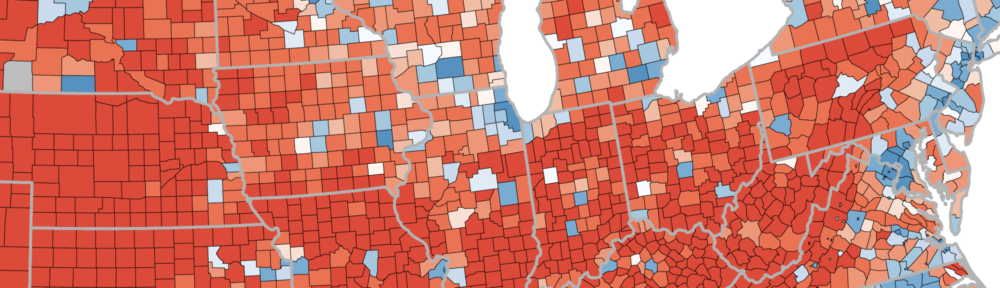
State Presidential vote trends, 1980-2024. Which states have shifted? Which are now in reach for either party? You need a large screen, at least a tablet, and zoom in. Pick your top 2 states to flip for each side. This year’s 7 swing states don’t count.
Here is a simple guide to the county votes for president and Senate in Wisconsin on November 5, 2024.
Donald Trump won 59 Wisconsin counties while Kamala Harris won 13.
Where does the vote come from and how much? The Democratic net vote comes with huge margins in Dane and Milwaukee counties, followed by much smaller margins in 11 other counties. The large Republican margins come from Waukesha and Washington. The many smaller Republican leaning counties collectively provide Republican strength, offsetting the fewer counties with Democratic majorities, despite the large margins in Dane and Milwaukee.
Harris improved over Biden’s 2020 vote percentage margin in only four counties, Washington, Ozaukee, Waukesha (the legendary Republican WOW counties around Milwaukee) and Door. She did a bit worse than Biden in Eau Claire, Dane and (especially) La Crosse, usually Democratic strong holds.
County vote margins for Senate
Baldwin won 14 counties, including Sauk which Trump won, while Hovde won 58.
While Baldwin only narrowly out-performed Harris, winning by .9 percentage points while Harris lost by .9 percentage points, Baldwin outperformed the presidential ticket in all but four counties: Menominee, Ozaukee, Waukesha and Washington.
A year ago there seemed to be a serious threat to Trump in the GOP. His name was DeSantis.
In March 2023, DeSantis won 35% to Trump’s 40% of GOP registered voters. (Haley was at 5%)
But DeSantis only lost ground through the year, while Trump gained.
Still, Trump didn’t move much past 50% until after Jan. 2024 once the primary process began.
As of Feb 5-15, 2024, pre-South Carolina primary, Trump holds 73% nationally to Haley’s 15% and DeSantis is no longer a candidate.
Trump rose modestly in the spring, then more in the fall, with a big jump by February. Haley was slow to rise, then bumped up in Nov. and Feb., but to only 15%.
The race that could have been.
DeSantis not only started strong but was a threat to Trump from within the Trump wing of the party. In March 2023 DeSantis got 32% among Reps *favorable* to Trump, plus 45% among those unfavorable to Trump.
Had DeSantis been able to expand that incursion into Trump land this could have been a real race. He did not. Instead DeSantis’s support fell across both Trump-favorable and Trump-unfavorable Republicans. Whether because of Trump’s effective attacks on DeSantis or the failures of DeSantis, the race that could have been was not.
Nikki Haley instead is the last contender standing against Trump, and yet she fails to reach even 20% support. She never was a contender with those who like Trump, not reaching even 6% among the Trump-favorable Republicans. But she has captured the wing of the GOP that does not like Trump, winning 65% of those Republicans.
For her, the tragedy is that nothing in the campaign succeeded in increasing the share of those unfavorable to Trump. Instead the opposite occurred, Trump’s favorability hovered around 70% until July, then rose to 80% in Sept. and stands at 84% in February.
As Haley has won an increasing share, now 2/3rds, of Republicans unfavorable to Trump, that pool has declined by half, from 30% to 16%. Even taking all of this smaller pool cannot make an alternative to Trump competitive in the primaries.
A year ago, 30% of Republicans were unfavorable to Trump, and DeSantis was eating into Trump-favorable Republicans. His effort failed. Haley has never won more than negligible support from the Trump-favorables, and even as she has consolidated the support of Trump-unfavorable Republicans, that group has been shrinking, to now less than one in five Republicans.
In March 2023 the GOP had a significant 30% who did not like Trump and a majority who supported someone else or were undecided. That moment has passed.